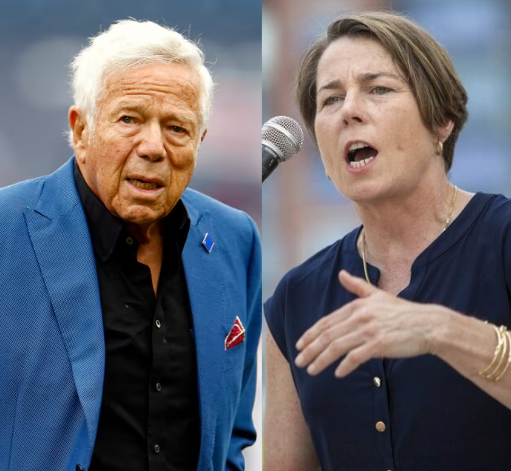
Foxborough, Massachusetts – Just 12 hours after owner Robert Kraft secured approval from 25 of 32 NFL teams to relocate the New England Patriots to New Hampshire, Governor Maura Healey dramatically escalated the high-stakes drama.
Earlier this week, Kraft had pushed the relocation plan forward, citing the need for modern infrastructure and long-term financial sustainability beyond Gillette Stadium. The vote appeared to make the move to New Hampshire nearly inevitable.
But in just 12 hours, everything changed.
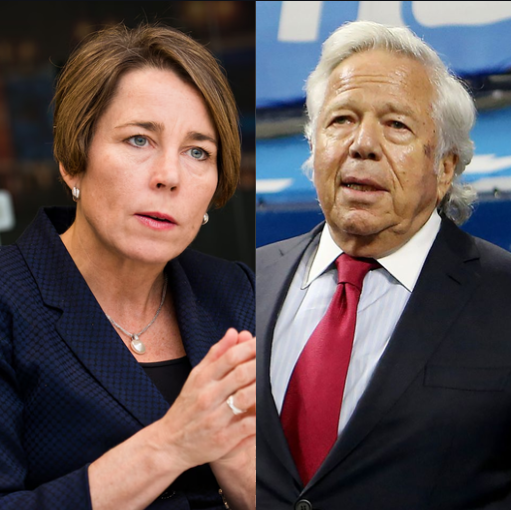
Healey quickly called an emergency “roundtable” meeting with New Hampshire Governor Chris Sununu and Robert Kraft to address the rapidly unfolding crisis.
According to sources close to the negotiations, the closed-door session was far from routine. It became a tense, high-pressure bargaining session aimed at keeping the historic franchise in Massachusetts.
After several hours of intense discussions, a new “power-balancing” agreement was reached and announced.
Under the deal, the Patriots will remain in Massachusetts for at least the next 10 years, but with a series of unprecedented conditions attached.
The Commonwealth of Massachusetts will commit hundreds of millions of dollars to upgrade sports infrastructure, including a major expansion and modernization of the training facilities and surrounding areas around Gillette Stadium. The team will also receive a “priority lane” in all state development projects — meaning faster permitting, easier access to public resources, and reduced bureaucratic hurdles.
However, the Patriots will remain subject to Massachusetts’ existing tax policies, including those affecting high-income individuals and business operations — one of the key factors that originally fueled relocation talks.
This creates a clear contradiction: the team gains development advantages while still facing significant financial pressures that prompted the initial move.
Governor Healey’s comments only heightened the tension.
“The Patriots are not just a football team — they are a cornerstone of this Commonwealth,” Healey stated firmly. “We will not allow them to leave under any circumstances. What we are building here is not merely a deal, but a long-term commitment to secure the future of this franchise in the best interest of Massachusetts and its people.”
Robert Kraft responded shortly after the announcement, and his words reflected deep frustration.
“We explored relocation not because we wanted to leave, but because we must think about the long-term viability of this team,” Kraft said. “New England is part of the Patriots’ identity, but if the commitments made today are not fully honored, we will have no choice but to protect the franchise’s future by any means necessary.”
Meanwhile, New Hampshire made its position crystal clear.
“If Massachusetts fails to deliver on its promises, New Hampshire stands ready with open arms,” Governor Chris Sununu said. “We have the infrastructure plans in place and will not hesitate to welcome the Patriots if the deal in Massachusetts falls through.”
The most critical part of the agreement is the contingency clause.
New Hampshire is now officially designated as the strategic Plan B. If any major commitments from Governor Healey’s side are not met, the Patriots will have the immediate right to relocate to New Hampshire without needing another full NFL owners’ vote.
New Hampshire is also authorized to continue preparing infrastructure, including potential training facilities and a sports complex, to be ready to receive the team at any moment.
The agreement has instantly divided the Patriots community and NFL observers.
One side views it as a pragmatic victory — keeping the team in New England while securing development guarantees and future flexibility. The other side fears it traps the franchise in perpetual political uncertainty and economic compromise.
Across the NFL, analysts are already calling this a dangerous precedent, where state politics and financial incentives have become deeply intertwined with professional sports operations.
For Robert Kraft, the deal preserves options while buying time. But for many longtime Patriots fans, the central question remains: Are the Patriots truly protected… or have they simply been pulled into a much larger power game between states?
One thing is certain — the controversy surrounding the future of the franchise is far from over.